

The US healthcare insurance market is a complex and highly competitive landscape, shaped by the interplay of national providers, regional leaders, and smaller, localized insurers. Each has its own strategy for addressing the needs of diverse populations, from densely populated metropolitan areas to sparsely inhabited rural counties.
By exploring these dynamics, we gain a deeper understanding of how insurance companies position themselves in the market, the factors that contribute to their regional strengths, and the critical role smaller insurers play in areas where larger providers have limited reach.
Understanding the Healthcare Insurance Landscape in the US
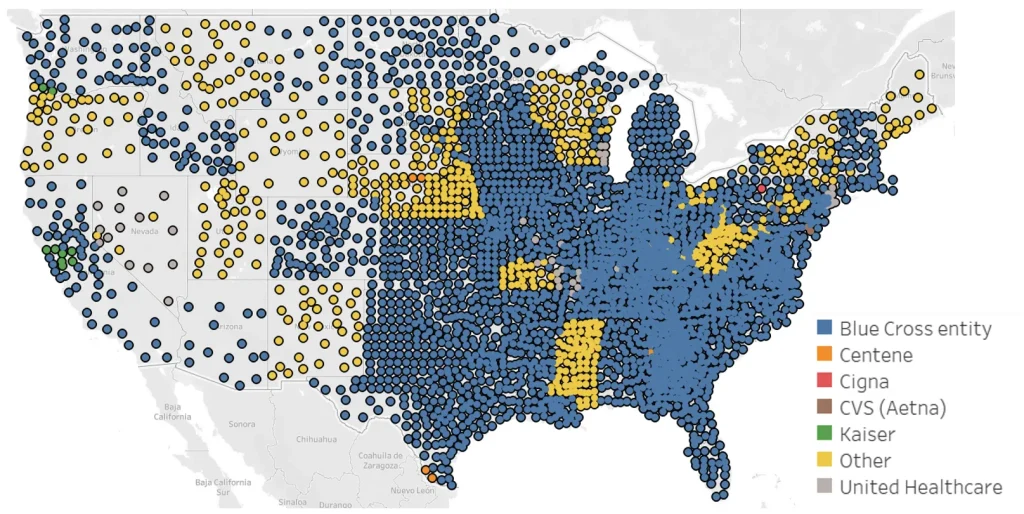
The map below provides a visual representation of how the healthcare insurance market is distributed across the United States. Each dot represents a county, color-coded by the dominant healthcare insurer in that county. This breakdown reveals insights into the dynamics of healthcare insurance dominance across the country.
Largest Market Share by County
Blue Cross Blue Shield’s Dominance
Blue Cross Blue Shield entities (marked in blue) dominate the US healthcare insurance landscape, with an overwhelming presence across a majority of counties. This is no surprise, given that Blue Cross Blue Shield is one of the largest and most established insurance networks in the country, often regarded as the go-to option for both individual and employer-sponsored health plans. The widespread coverage highlights the organization’s ability to cater to diverse populations, from rural areas to metropolitan centers, making it a cornerstone of the US healthcare system.
Regional Leaders Among National Insurers
While Blue Cross Blue Shield dominates the market, other top healthcare insurers carve out significant, yet regionally limited, shares.
United Healthcare (grey): Though the second-largest health insurer nationwide, its dominance is confined to relatively few counties, often in urban and suburban areas with higher population densities.
CVS (Aetna) (orange): Aetna’s market presence reflects its strategic focus on specific urban and semi-urban areas, leveraging its retail pharmacy footprint through CVS integration. Cigna (red): Cigna’s dominance is even more restricted, maintaining control in select counties with a focus on employer-sponsored plans and integrated care models.
Kaiser (green): With its vertically integrated system of insurance and healthcare delivery, Kaiser dominates primarily in the Western US, such as California, where it maintains a stronghold due to its unique model.
Small Local Insurers and the ‘Other’ Category
The yellow dots representing “Other” insurers showcase the role of small, local healthcare insurance companies in meeting the needs of specific counties. These local players often dominate in areas where national insurers have limited reach or where residents prefer the tailored offerings of regional plans. Such insurers play a critical role in bridging coverage gaps, particularly in rural and underserved areas.
Blue Cross Blue Shield
Blue Cross Blue Shield (BCBS) dominates the US healthcare market as a collective enterprise, though the extent of its dominance depends on how its market presence is analyzed. BCBS is not a single entity but a federation of 34 independent, locally operated companies that together serve a significant portion of the US population, covering millions of Americans.
With a vast provider network, BCBS holds a competitive edge over other insurers. The federation manages a large share of employer-sponsored plans, government programs such as Medicare Advantage and Medicaid, and individual plans under the Affordable Care Act. Additionally, BCBS is a leading insurer for the Federal Employee Health Benefits Program (FEHBP), further solidifying its influence.
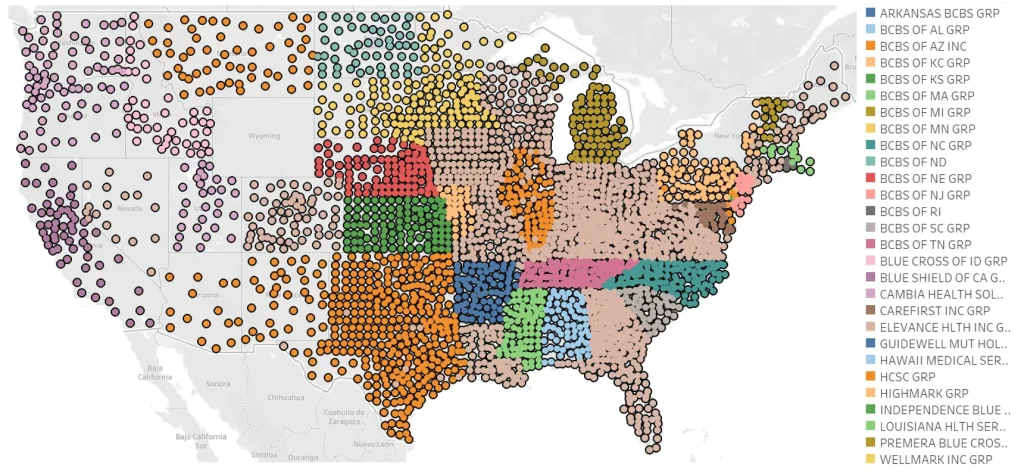
However, BCBS’s dominance comes with limitations. Its structure as a federation of independent companies means that its market power is not always unified or leveraged as a single entity. While BCBS’s collective market share and geographic reach undoubtedly establish it as a dominant force in US healthcare, its fragmented organization prevents it from functioning as a monolithic enterprise. The map highlights the regional focus of these entities, showing that BCBS affiliates dominate specific states or clusters of states. For example, BCBS of Arizona exclusively covers Arizona, while entities like Highmark or Anthem span multiple states. The western states, including California, Idaho, and Oregon, are covered by distinct BCBS affiliates, whereas the Midwest and South show a denser clustering of dots corresponding to entities such as BCBS of Michigan, BCBS of Alabama, and HCSC (covering states like Illinois and Texas). This layout underscores the localized approach of BCBS affiliates, each operating independently to provide coverage within their designated territories while collectively forming a nationwide network.
Blue Cross Entities Markets by County
Domination When BCBS is Not Considered
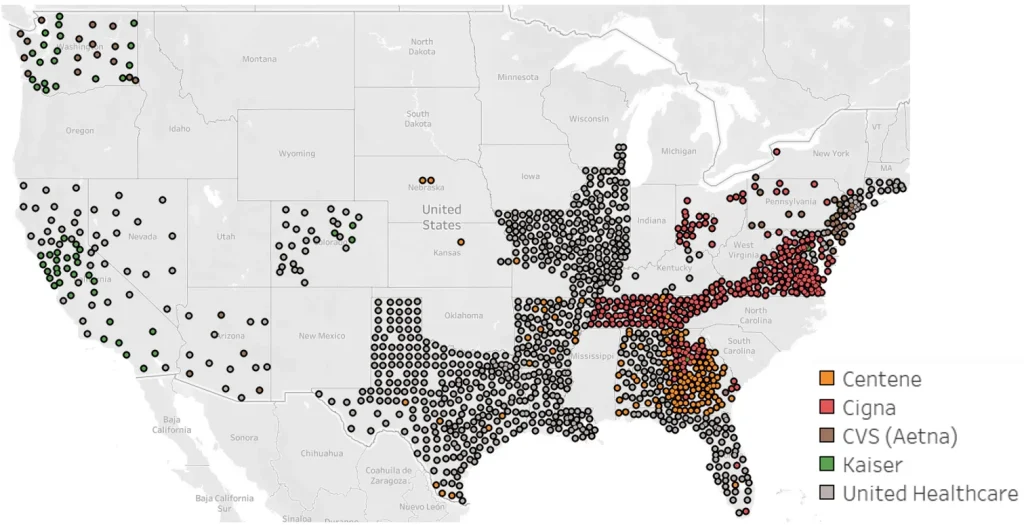
This map below visualizes the leading healthcare insurance companies by market share across counties in the United States, excluding Blue Cross Blue Shield entities. Counties where smaller insurance providers dominate the market are not shown. Each colored dot represents the company with the highest market share in a given county. United Healthcare (grey) dominates a significant portion of counties, particularly in central and eastern regions. Cigna (red) has a notable presence in the Southeast, while Centene (orange) leads in specific areas across the Midwest and South. CVS (Aetna) (brown) and Kaiser (green) show strongholds in the West, particularly in California and some surrounding states. The map provides a clear overview of the geographical market dominance of these major insurance companies, reflecting competitive regional dynamics within the healthcare insurance industry.
Market Shares of Top Insurers when Excluding BCBS
Private Insurance Members by State
The state-by-state breakdown below underscores the complexity and regional variation in the US healthcare insurance landscape, reflecting both the strength of national providers and the importance of localized, smaller-scale insurers in meeting the needs of specific populations. Together, this data provides a detailed look at how market share is distributed across the nation.