Rising Costs, Declining Payments
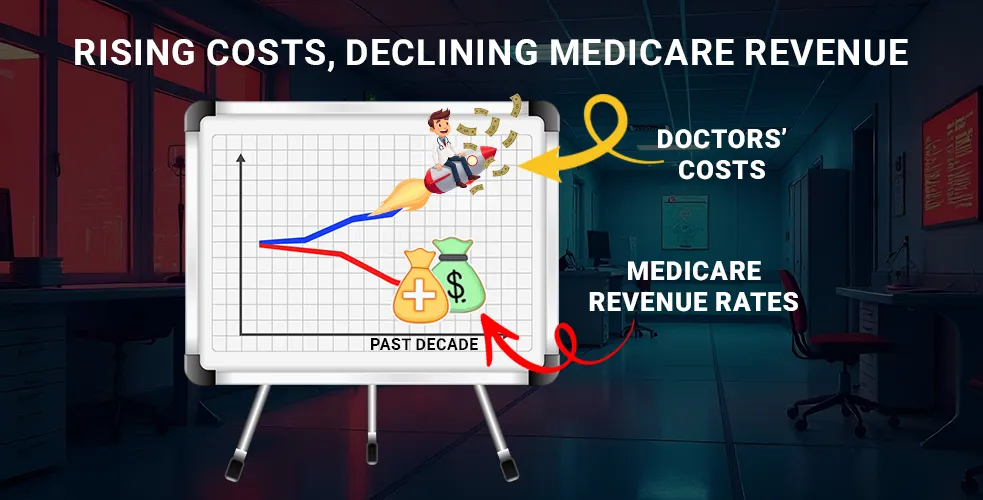
Imagine running a business where your expenses rise by 30%, but your income declines by 10%. That’s the reality for thousands of doctors serving Medicare patients today. While the costs of running a medical practice continue to soar, Medicare’s reimbursement rates for outpatient services have steadily declined. The data tells a stark story—one that underscores the growing financial strain on physicians and the potential consequences for patient care.
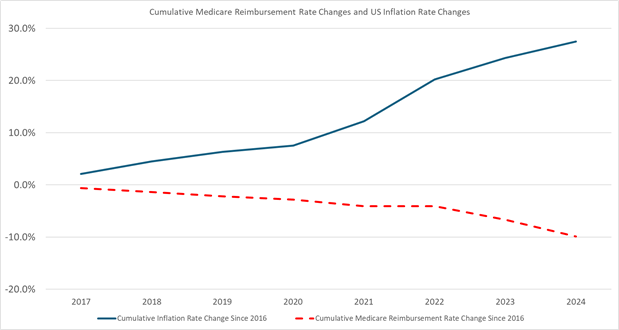
The chart above highlights a crucial disparity:
- Since 2016, cumulative US inflation has risen by almost 30%, significantly increasing the cost of staff salaries, rent, medical supplies, and technology.
- Meanwhile, Medicare reimbursement rates for outpatient procedures have declined by approximately 10%.
This means that physicians are getting paid less for the same services while their operational expenses continue to rise. For many doctors – especially those in independent practices – this financial squeeze threatens their ability to continue accepting Medicare patients.
Specialty Disparities: Who Gets Paid More?

While all physician specialties have experienced flat or declining Medicare reimbursement rates, the differences between primary care and specialists are striking.
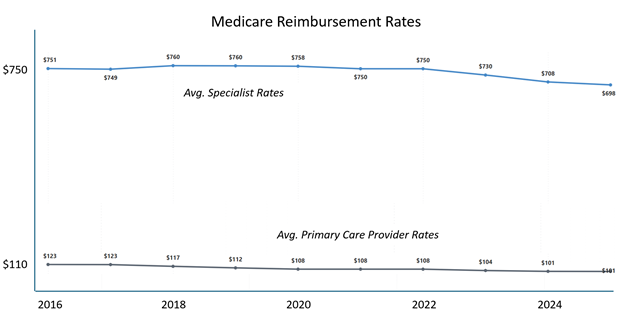
For primary care providers, Medicare reimbursement is predominantly based on Evaluation & Management (E&M) CPT codes—which cover time-intensive office visits, consultations, and patient care management. These include:
- 99202-99205 (New patient visits)
- 99211-99215 (Established patient visits)
- 99381-99397 (Preventive care services)
However, E&M services are reimbursed at significantly lower rates than procedures or surgeries, despite requiring substantial cognitive effort and time investment. Medicare assigns lower Relative Value Units (RVUs) to these visits compared to procedural codes, even though primary care plays a crucial role in preventing costly hospitalization and managing chronic conditions.
In contrast, specialists primarily bill procedural CPT codes, which carry much higher reimbursement rates. Examples include:
- Cardiology: 93000 (EKG with interpretation), 93306 (Echocardiogram)
- Orthopedics: 20610 (Joint injection), 27130 (Total hip replacement)
- Gastroenterology: 45378 (Colonoscopy)
- Dermatology: 17000 (Destruction of skin lesions)
A 2025 Medicare reimbursement rate analysis highlights the gap:
- Primary care E&M visits: $101 (lowest average reimbursement)
- Cardiovascular surgery: $1,023 per procedure
- Nervous system surgery: $935 per procedure
- Radiology services: $176 per service (still higher than primary care visits)
Medicare 2025 Reimbursement Rate Averages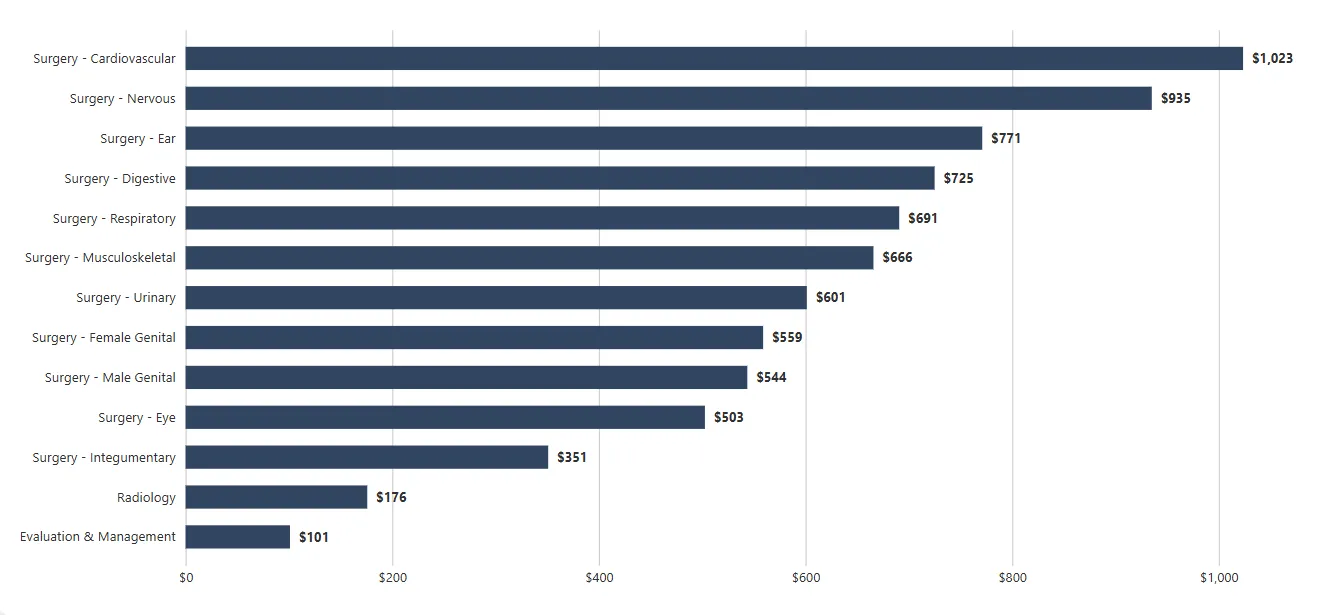 This imbalance disincentivizes medical students from entering primary care, widening the shortage of frontline physicians and further straining an already overburdened healthcare system.
The Commercial Insurance Factor: Following Medicare’s Lead

Historically, commercial insurance companies have used Medicare reimbursement rates as a benchmark, often setting their payments at a percentage above or below Medicare rates. As Medicare rates stagnate or decline, commercial insurance rates may follow suit.
Compounding this issue, commercial insurers have shifted a greater share of costs onto patients through:
- Higher deductibles
- Co-insurance payments
- Increased out-of-pocket maximums
As a result, even when commercial insurers reimburse providers at higher rates than Medicare, doctors must collect more directly from patients, creating additional administrative burdens and increasing the risk of unpaid bills.
The result? More financial stress on primary care providers and greater barriers to care for patients.
The Impact on Physicians and Patients
For Physicians:
- Lower revenue despite rising expenses
- Difficulty investing in new technology and staffing
- Increased pressure to see more patients in less time
- Growing hesitancy to accept Medicare patients
For Patients:
- Fewer primary care providers accepting Medicare
- Longer wait times for appointments
- Potential for increased emergency room visits due to lack of access
Reversing the Decline: What Needs to Change
While Medicare reimbursement reductions may be aimed at cost containment, they fail to account for the financial realities facing physicians. Without adjustments that at least keep pace with inflation, many providers may be forced to cut services or stop seeing Medicare patients altogether.
To ensure long-term access to care, policymakers must rethink how reimbursement rates are structured. Solutions could include:
- Adjusting the Medicare conversion factor to reflect inflation.
- Increasing RVU valuations for primary care E&M services.
- Expanding alternative payment models (APMs) to better support preventive and chronic disease management.
Without reform, the financial strain on physicians will continue to erode patient access and healthcare quality – an outcome that benefits no one.