Recapping key insights from our Becker’s Healthcare webinar on Disparate Technology Integration
If you missed our recent Becker’s Healthcare webinar, “Don’t Let Fragmented Systems Limit Performance,” this recap outlines key takeaways from the discussion and why this topic is more urgent than ever.
We spoke with healthcare leaders across hospitals, IPAs, and multi-site provider organizations. Many are navigating growth while dealing with disconnected EHRs, financial systems, and legacy processes. The challenges are consistent and familiar.
Watch the full webinar recording:
What We Covered
Here’s a brief look at the challenges we discussed and how healthcare organizations are solving them without overhauling their entire tech stack.
The Problem: Fragmented Systems and Delayed Decisions
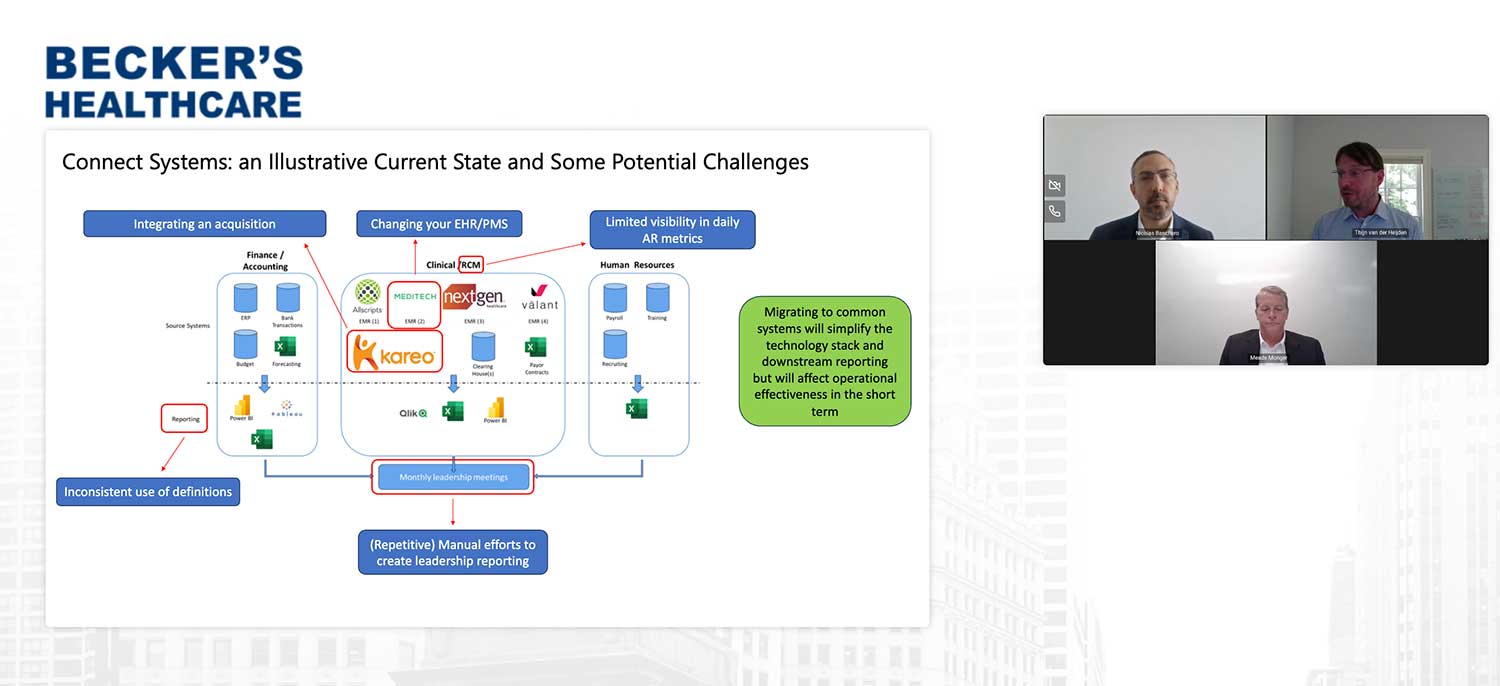
Across the board, leaders described similar pain points:
- Dozens of systems that don’t communicate with one another
- Financial teams buried in spreadsheets, with close processes taking weeks
- KPI definitions that vary by department or location
- Manual workarounds that slow operations and contribute to burnout
One attendee asked:
“Once you surface insights across systems, how do you ensure action is actually taken?”
We shared how real-time dashboards and standardized scorecards enable leadership teams to focus on facts rather than assumptions. Organizations are using these tools to align regional managers, physicians, and clinical operations around shared performance data.
The Solution: One Platform, Deployed in 90 Days
We walked through our approach to building an integrated data platform. There’s no need to rip and replace existing systems.
Here’s what it looks like in practice:
- A roll-up with more than 30 PMS and EHR systems unified its data in under three months
- A provider preparing to go public reduced its month-end close process from eight weeks to one
- A large hospital system using Epic created a gold-layer dataset to serve as a single source of truth
- An IPA with hundreds of practices replaced manual file collection with automated feeds mapped to a shared model
Behind the Scenes: How the Tech Works
We demonstrated how the platform connects to on-premise or cloud-based systems via API, ingests data into a raw layer, then standardizes it through a common data model. The final step delivers insights through a semantic “gold layer.”
This approach enables:
- Revenue dashboards by doctor or location
- Real-time eligibility checks, prior authorization logic, and reconciliation automation
- Consistent definitions across all systems
- Elimination of data disputes and manual validation cycles
One Powerful Quote from the Q&A
“We haven’t met an EMR or PMS system we couldn’t tap into.”
This insight resonated with attendees who are working with older or proprietary tools. It highlights the value of owning the data pipeline rather than relying on third-party aggregators with limited transparency or flexibility.
What You Can Do Next
If your organization is facing reporting delays, still reliant on Excel, or unsure how to scale after an acquisition, we’re here to help.
Contact us to explore how Omniscient Health can support your integration strategy.
We’ll also be publishing additional content in the coming weeks, including deeper dives into automation, payer analytics, and financial performance optimization.