In the world of primary care, time is everything. Every minute spent on patient documentation is a minute that could be spent on direct patient care. However, today’s primary care providers (PCPs) are increasingly burdened by electronic health record (EHR) documentation, limiting the number of patients they can see in a day.

The Documentation Burden in Primary Care
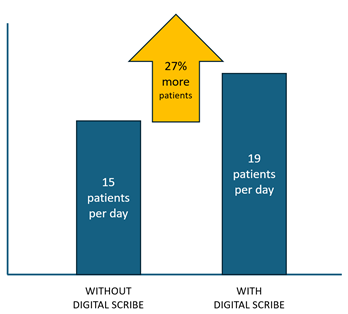
Research shows that PCPs currently see an average of 15 patients per day, constrained by the extensive time required for documentation. With an 8-hour (480-minute) workday, this means that on average, PCPs spend 32 minutes per patient – including both face-to-face time and charting. Given that EHR documentation alone consumes a significant portion of this time, it’s clear why many primary care providers struggle to accommodate more patients.
How Digital Scribes Free Up More Time
Digital scribes, powered by AI-driven transcription and automation, have emerged as a solution to reduce the burden of documentation. Studies indicate that using a digital scribe can reduce the time PCPs spend on documentation by an average of 6.9 minutes per patient. This efficiency gain allows physicians to reallocate their time, enabling them to see more patients per day without extending their work hours.
The Impact: 27% More Patients Per Day
By cutting documentation time, digital scribes help PCPs increase the number of patients they can see from 15 to over 19 per day – a 27% increase. This improvement means:
-
- Better patient access: More appointments available for those in need.
-
- Reduced physician burnout: Less after-hours documentation (“pajama time”).
-
- Improved revenue potential: Seeing more patients leads to greater financial stability for primary care practices.
From Typing to Talking: How Digital Scribes Transform Physician Workflows
Traditionally, doctors must manually enter patient information into electronic health records (EHRs) at multiple stages—before, during, and after each visit—resulting in hours of administrative work and increased physician burnout. However, digital scribes are changing the game by automating documentation, allowing doctors to shift their focus from typing to talking. This shift enhances patient interactions, reduces after-hours work, and increases efficiency.

Without a digital scribe, primary care providers (PCPs) must manually enter patient information into the electronic health record (EHR) at multiple stages of the visit. Before seeing a patient, they review and pull relevant history from the EHR. During the visit, updates such as vitals and nurse discussions must be documented in real-time, requiring constant typing. After the appointment, the physician spends additional time writing detailed notes, often extending into after-hours work, commonly known as pajama time. This extensive documentation process reduces the time available for patient care and contributes to physician burnout.
With a digital scribe, the documentation workflow becomes significantly more efficient. The physician and medical assistant (MA) can focus entirely on the patient, as the doctor records the visit using a smartphone, microphone, or AI-powered system instead of typing. The recorded conversation is then automatically transcribed and structured into a doctor’s note by the digital scribe software, reducing the need for manual data entry. This automation allows physicians to spend more time with patients, decrease after-hours documentation, and improve overall work-life balance.
A Step Toward Solving the Primary Care Crisis
The demand for primary care continues to grow, yet many providers are struggling to keep up due to the overwhelming administrative workload. Digital scribes offer a practical, scalable solution to optimize efficiency, allowing PCPs to focus more on patient care and less on paperwork. With technology continuing to reshape healthcare, could digital scribes be the key to reversing physician burnout and expanding patient access? The data suggests the answer is a resounding yes.